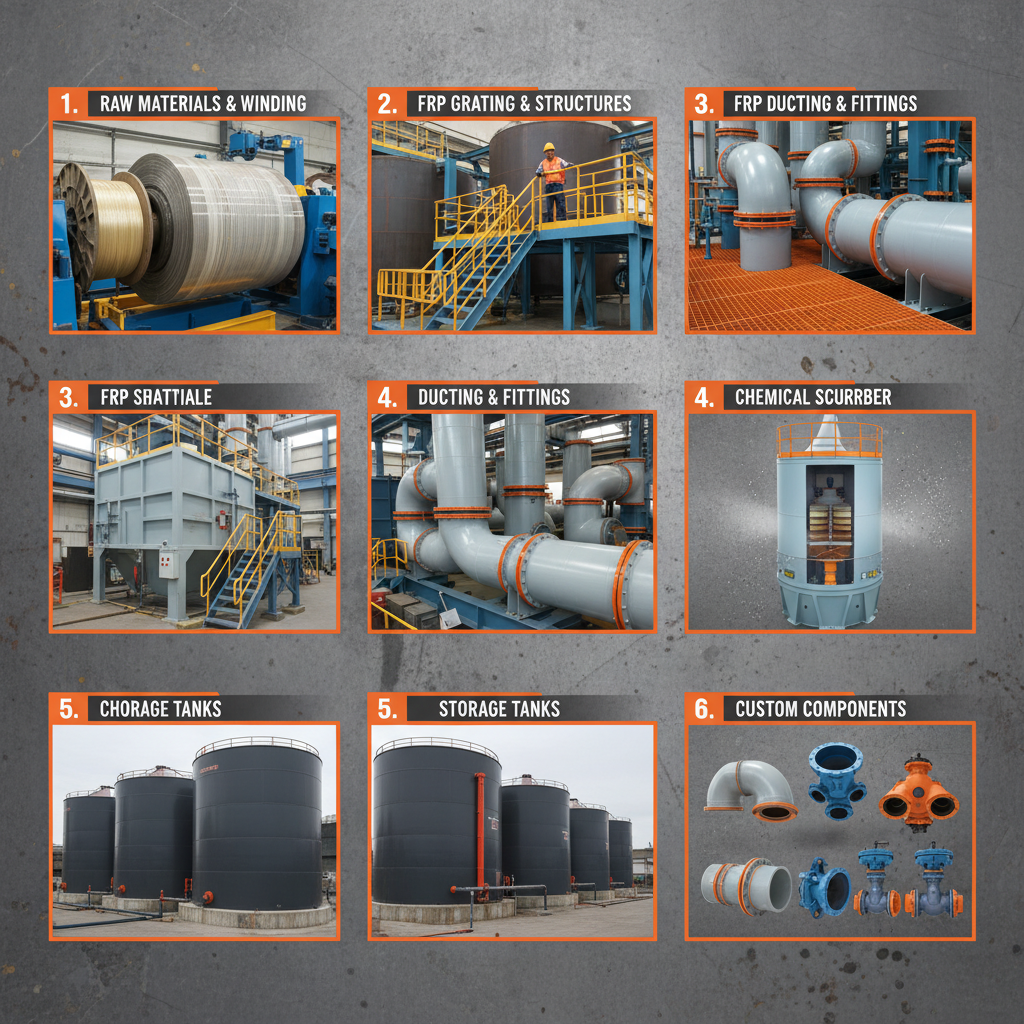
Honestly, things are moving fast these days. Everyone's talking about prefabrication, modular builds, off-site construction… all driven by the labor shortage, you know? And the push for speed. But speed isn’t worth a dime if it means sacrificing quality. I’ve seen too many projects cut corners, and it always comes back to haunt you.
What’s really been on my mind lately is the detailing. It’s easy to get caught up in the big picture – the overall design, the logistics – and forget about the small stuff. Those little connections, the interfaces between modules, the way the frp fitting integrates… that’s where projects really live or die. We spend so much time in the design phase talking about tolerances, but when it hits the site… well, reality’s a different beast.
The biggest trend I’m seeing, and honestly, it’s a good one, is more focus on durability. Folks are finally realizing that ‘cheap’ doesn’t mean ‘value’ in the long run. They're asking for materials that can withstand the elements, the wear and tear, and frankly, the inevitable abuse that happens on a construction site.
The Changing Landscape of Modular Construction
You know, it used to be modular meant ‘temporary’. Like those site offices. But now? Now it's high-end apartments, hospitals, even schools. And that demands a completely different level of frp fitting. We're talking about long-term structural integrity, fire resistance, weatherproofing… It's not just slapping things together anymore.
The demand for quicker turnaround times is also driving innovation in frp fitting techniques. More pre-assembly, more standardized components, and a whole lot more reliance on precision manufacturing. Frankly, it's about time.
The Devil is in the Details: Design Pitfalls
Have you noticed how architects sometimes design things that just… don’t make sense on site? Beautiful drawings, all sleek lines and impossible angles. Then you get a structural engineer looking at it and realizing it’s going to need a custom frp fitting for every single connection. And that, my friend, translates to delays and a budget blowout. It's a classic.
One common mistake is underestimating the tolerances. These modules aren't built in a vacuum. They get shipped, handled, and assembled in less-than-ideal conditions. If the frp fitting doesn’t allow for some wiggle room, you’re going to have a nightmare trying to make everything line up.
Another thing? Ignoring the weight distribution. Add a ton of concrete and steel to one side, and you’ll need seriously robust frp fitting to handle the load. It’s basic physics, but you’d be surprised how often it’s overlooked.
Materials: The Feel, the Smell, the Reality
Now, when we talk about materials, it's not just about the specs on a datasheet. You gotta know what you're working with. Take galvanized steel, for example. It feels solid, right? But it can be brittle, especially in cold weather. And that zinc smell... strong stuff. You need proper ventilation when you're cutting and welding.
Then you've got composites. Carbon fiber, fiberglass – lightweight, strong, but also expensive. And strangely, they can be a pain to inspect visually. Damage doesn’t always show up right away. You need specialized techniques for non-destructive testing.
And let’s not forget good old-fashioned PVC. Cheap, versatile, but not exactly the most glamorous material. But for certain applications – like drainage and conduit – it’s perfectly adequate. The frp fitting for PVC needs to be spot on, though. A bad connection there can lead to leaks and a whole lot of headaches.
Real-World Testing: Beyond the Lab
Lab tests are important, sure. But they don’t tell the whole story. I encountered this at a factory in Qingdao last time, they were bragging about their super-strength frp fitting based on lab results. But I asked them, “Have you ever dropped a module from a crane?” They looked at me like I was crazy.
You need to simulate real-world conditions. Wind loads, seismic activity, temperature fluctuations, even just the vibrations from heavy machinery. We do a lot of load testing on site, putting weight on the frp fitting, shaking things around, seeing what breaks. It's messy, it's loud, but it's honest.
frp fitting Performance Under Different Stressors
How Users Actually Use It
You know, we design these frp fitting systems with a certain use in mind. But the guys on the ground? They always find a way to do things a little differently. I’ve seen them use them as makeshift levers, as wedges, even as hammers. You can’t plan for everything.
What's important is that the system is forgiving. That it doesn't fail catastrophically if someone misuses it. A little bending, a little flexing… that’s okay. But if it snaps, if it breaks, that's when you have a problem.
Advantages, Disadvantages, and Everything In Between
The biggest advantage of using these modern frp fitting systems? Speed. No doubt about it. You can assemble modules much faster than with traditional methods. And that translates to cost savings. But… there’s always a ‘but’… the initial investment is higher. You need specialized tools, trained personnel, and a more sophisticated supply chain.
Another advantage is the precision. Everything is manufactured to tight tolerances, which means fewer on-site adjustments. But that also means that if something is wrong, it’s hard to fix. You can’t just fudge it like you used to. And frankly, I miss the days when you could just grab a hammer and make things work. It was less precise, but more… satisfying.
Customization and Specific Applications
We had a small boss in Shenzhen last month, making smart home devices. He insisted on changing the interface on all our frp fitting to , because "everyone is using now!" Sounded good in theory. But it turned out the existing mounting system was designed for the older connectors. We spent a week redesigning the whole thing, just to accommodate his whim. In the end, he admitted it probably wasn't worth it. It's a good reminder that customization needs to be justified.
Now, serious customization does have its place. We've done projects where we needed to design frp fitting for extremely tight spaces, or for unusual load conditions. But that requires careful engineering and a lot of testing.
Summary of frp fitting Performance Across Different Application Scenarios
| Application Scenario |
Load Capacity (tons) |
Environmental Resistance (1-5) |
Installation Complexity (1-5) |
| Residential Modular Buildings |
5-10 |
4 |
2 |
| Industrial Facility Construction |
10-20 |
3 |
3 |
| Emergency Shelter Deployment |
3-7 |
2 |
1 |
| High-Rise Building Construction |
20+ |
5 |
4 |
| Infrastructure Projects (Bridges, etc.) |
50+ |
5 |
5 |
| Data Center Construction |
8-15 |
4 |
3 |
FAQS
Honestly, the biggest challenge is maintaining accuracy across all the modules. Even a small misalignment can snowball into a major headache during assembly. We also see issues with transportation damage if the frp fitting isn't properly protected. It’s all about planning and attention to detail. And having a good QA/QC process in place. Because if something’s wrong at the factory, it’s a lot harder – and more expensive – to fix it on site.
Initially, frp fitting can be more expensive upfront. You're paying for the precision manufacturing and specialized materials. However, when you factor in the labor savings – because things go together faster and with fewer errors – the overall cost often evens out. And in the long run, the increased durability and reduced maintenance can actually make it cheaper. It really depends on the project scope and complexity.
That’s a good question. Depending on the environment, we use a variety of corrosion protection methods. Galvanizing is common for steel components, of course. For composites, we often use epoxy coatings or specialized resins. And in particularly harsh environments – like coastal areas – we might even use cathodic protection. It’s about choosing the right system for the specific application.
Absolutely. Look for certifications like ISO 9001 to ensure quality management. And depending on the application, you might need to comply with specific building codes or industry standards. For example, if you’re building a hospital, you’ll need to meet strict fire safety regulations. Don't skip on this step - it could save you a lot of trouble later on.
Yes, it absolutely can! That's a growing area of application. frp fitting can be used to strengthen existing concrete or steel structures, improve their seismic resistance, or repair damage. It's a less disruptive and often more cost-effective alternative to complete demolition and reconstruction. The key is proper assessment of the existing structure and careful design of the retrofit system.
Lead times can vary quite a bit depending on the complexity of the design, the availability of materials, and our current workload. Generally, for standard components, we can deliver within a few weeks. But for custom designs, it can take 6-8 weeks, or even longer. Planning ahead is crucial. We always advise our clients to get their orders in as early as possible to avoid delays.
Conclusion
So, yeah, frp fitting… it's not just about bolts and screws. It's about understanding the whole process, from design to fabrication to installation. It's about anticipating problems and having solutions ready. It’s about finding that balance between speed, cost, and quality. Ultimately…
…whether this thing works or not, the worker will know the moment he tightens the screw. And if he smiles, you’ve probably done something right. Check out our full range of frp fitting solutions at jrain-frp.com.