
-
 Afrikaans
 -
 Albanian
 -
 Amharic
 -
 Arabic
 -
 Armenian
 -
 Azerbaijani
 -
 Basque
 -
 Belarusian
 -
 Bengali
 -
 Bosnian
 -
 Bulgarian
 -
 Catalan
 -
 Cebuano
 -
 China
China -
 China (Taiwan)
 -
 Corsican
 -
 Croatian
 -
 Czech
Czech -
 Danish
 -
 Dutch
Dutch -
 English
 -
 Esperanto
 -
 Estonian
 -
 Finnish
 -
 French
 -
 Frisian
 -
 Galician
 -
 Georgian
 -
 German
 -
 Greek
Greek -
 Gujarati
 -
 Haitian Creole
 -
 hausa
hausa -
 hawaiian
 -
 Hebrew
 -
 Hindi
Hindi -
 Miao
Miao -
 Hungarian
 -
 Icelandic
 -
 igbo
igbo -
 Indonesian
 -
 irish
irish -
 Italian
 -
 Japanese
 -
 Javanese
 -
 Kannada
 -
 kazakh
 -
 Khmer
Khmer -
 Rwandese
 -
 Korean
 -
 Kurdish
 -
 Kyrgyz
 -
 Lao
Lao -
 Latin
Latin -
 Latvian
 -
 Lithuanian
 -
 Luxembourgish
 -
 Macedonian
 -
 Malgashi
 -
 Malay
Malay -
 Malayalam
 -
 Maltese
 -
 Maori
Maori -
 Marathi
 -
 Mongolian
 -
 Myanmar
 -
 Nepali
 -
 Norwegian
 -
 Norwegian
 -
 Occitan
 -
 Pashto
 -
 Persian
 -
 Polish
 -
 Portuguese
 -
 Punjabi
 -
 Romanian
 -
 Russian
 -
 Samoan
 -
 Scottish Gaelic
 -
 Serbian
 -
 Sesotho
 -
 Shona
Shona -
 Sindhi
 -
 Sinhala
 -
 Slovak
 -
 Slovenian
 -
 Somali
 -
 Spanish
 -
 Sundanese
 -
 Swahili
 -
 Swedish
 -
 Tagalog
 -
 Tajik
Tajik -
 Tamil
Tamil -
 Tatar
Tatar -
 Telugu
 -
 Thai
Thai -
 Turkish
 -
 Turkmen
 -
 Ukrainian
 -
 Urdu
Urdu -
 Uighur
 -
 Uzbek
Uzbek -
 Vietnamese
 -
 Welsh
Welsh -
 Bantu
Bantu -
 Yiddish
 -
 Yoruba
 -
 Zulu
Zulu


What is fiber glass pipe?
What is fiber glass pipe?
Fiber glass pipe is a type of composite pipe made from glass fibers embedded in a resin matrix. It is also known as glass-reinforced plastic (GRP) or glass-fiber reinforced epoxy (GRE) pipe.
In this blog post, we will explain what composite materials are and raw material related to fiber glass pipes.
What are composite materials?
Composite materials are made from two or more different materials that have different physical or chemical properties. When these materials are combined, they create a new material that has different characteristics from the original ones. The original materials remain separate and distinct within the new material.
For example, concrete is a composite material made from cement, sand, gravel, and water. The cement acts as a binder that holds the other materials together. The sand and gravel provide strength and stability to the concrete. The water helps the cement to harden and cure.
Fiber glass pipes are composite materials made from glass fibers and resin. The glass fibers act as reinforcement that provide strength and stiffness to the pipe. The resin acts as a binder that holds the fibers together and protects them from corrosion and damage.
What are the materials involved in their production? In this blog post, we will answer these questions and give you a brief overview of the process of making fiberglass pipes.
Scrubbers
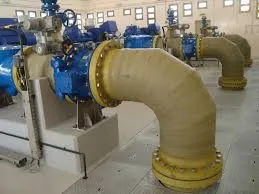
All fiber glasses begin as individual filaments of glass drawn from a furnace of molten glass. Many filaments of glass are formed simultaneously and gathered into a strand.
Glass fibers are designed for several applications, some of which are for applications in an acid, alkali or other chemical environment.
The mechanical strength of a fiberglass product depends upon the amount, type and arrangement of glass fiber reinforcement within the material system and increases proportionally with the amount of glass fiber reinforcement. There are generally two types of glass used. E- Glass and ECR glass (Electrical/Chemical Resistance).
Resins: The second major component of fiberglass piping is the thermosetting resin system.
Thermosetting plastics are resins that undergo an irreversible reaction when cured in the presence of a catalyst. They cannot be re melted and are insoluble.
Different types of fiber glass pipes are made based on the resin used and the manufacturing method. Ex: GRP polyester resin, GRE Epoxy resin GRV vinyl ester resin.The resin system is chosen for its chemical, mechanical and thermal properties.


Latest news
-
Oblate Tanks: Space-Saving, Durable Liquid Storage SolutionsNewsAug.27,2025
-
High-Performance Piping System Solutions for Industry & Commercial UseNewsAug.26,2025
-
Precision Fittings: Durable & Reliable Industrial & Plumbing SolutionsNewsAug.25,2025
-
Practical Steps: Unlock Success with Our Proven GuidesNewsAug.24,2025
-
Transport Tanks: Safe, Durable & Efficient Liquid HaulingNewsAug.23,2025
-
High-Quality Piping Systems for Efficient Flow & DurabilityNewsAug.22,2025